
Introduction
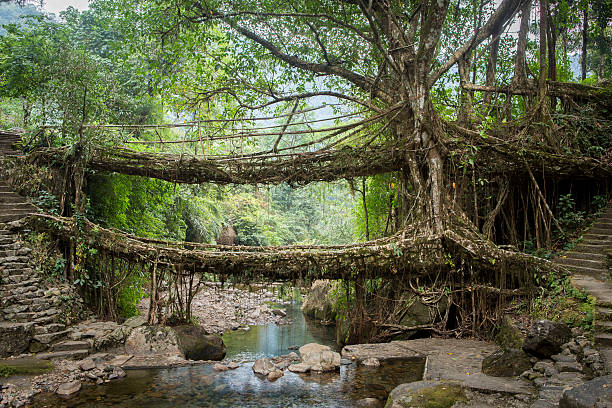
If there’s one thing that shows up on every North East India bucket list, it’s a living root bridge — a structure literally grown, over decades, from the roots of rubber fig trees by the Khasi tribes of Meghalaya. But here’s where most first-time travellers get confused: there isn’t just one root bridge to visit, and the two most famous ones — the Double Decker Root Bridge at Nongriat and the single-level root bridge at Mawlynnong (Riwai village) — are completely different experiences in terms of effort, time, and fitness required.
One is a gentle, 10-minute walk suitable for nearly anyone. The other is a genuinely demanding trek involving roughly 3,500 stone steps each way. Choosing the wrong one for your fitness level or time budget can either leave you disappointed (an easy walk when you wanted adventure) or completely exhausted (a punishing trek when you just wanted a quick photo stop).
As the best travel agency in Siliguri, AKKCRUSIER PRIVATE LIMITED plans Meghalaya itineraries for travellers of every fitness level, and this guide breaks down exactly which root bridge — or both — makes sense for your trip.
Quick Comparison: Nongriat vs Mawlynnong Root Bridge
| Factor | Nongriat (Double Decker) | Mawlynnong/Riwai (Single Root Bridge) |
|---|---|---|
| Difficulty | High — steep, strenuous trek | Low — short, gentle walk |
| Distance | ~3 km one-way (approx. 3,500 steps each way) | ~300–500 metres, mostly flat with minimal stairs |
| Time Required | 4–6 hours round trip (or overnight) | 30–45 minutes round trip |
| Fitness Level Needed | Good fitness, sturdy knees, trekking experience helpful | Suitable for nearly all ages and fitness levels |
| Structure | Two root bridges stacked vertically — the only one of its kind in the world | Single-level root bridge, still impressive but simpler |
| Distance from Shillong | ~90 km via Cherrapunji to Tyrna, then trek | ~75–80 km via Cherrapunji/Pynursla |
| Best For | Adventure seekers with a full day (or overnight) to spare | Families, elderly travellers, or anyone short on time |
Option 1: Nongriat’s Double Decker Root Bridge
What Makes It Special
The Umshiang Double Decker Root Bridge at Nongriat is the only naturally-grown, two-tiered root bridge in the world — two living root bridges stacked one above the other, spanning the Umshiang River deep in the Cherrapunji forest. It’s often described as one of the most rewarding, and most physically demanding, experiences in all of Meghalaya.
The Trek: What to Expect
- Starting point: The trek begins at Tyrna village, roughly 12–15 km from Cherrapunji (Sohra), reachable by road.
- The descent: From Tyrna, you descend approximately 3,500 stone steps through dense forest, crossing several smaller root bridges and streams along the way — including the Umunoi and Mawsaw root bridges, which make for good rest-stop photo points.
- Distance: Around 3 km one-way, with a total elevation drop of roughly 2,500 feet.
- Duration: Typically 4 to 6 hours round trip if done as a single-day trek, including time at the bridge itself. The descent takes around 1.5–2 hours; the climb back up takes noticeably longer.
- The return climb: This is the part that catches people off guard — what feels manageable on the way down becomes a genuinely tough uphill climb of the same 3,500 steps on the way back. Sturdy knees and reasonable fitness matter here.
- What’s at the bottom: Beyond the Double Decker bridge itself, Nongriat village has crystal-clear natural pools perfect for a swim, and the trek can be extended further to Rainbow Falls, an additional worthwhile detour for those with energy to spare.
Should You Stay Overnight?
Many experienced trekkers recommend staying overnight at a homestay in Nongriat village rather than attempting the full round trip in a single day. This splits the descent and ascent across two days, gives you time to properly enjoy the bridge and surrounding pools without rushing, and takes real pressure off your knees. If your schedule allows even one extra day in Cherrapunji, this is genuinely the more enjoyable way to do it.
Who Should Attempt This Trek
- Travellers with good general fitness and no significant knee or joint issues
- Anyone comfortable with steep, uneven stone steps for extended periods
- Adventure-focused travellers who see the trek itself as part of the experience, not just an obstacle to a photo
- Not recommended for young children, elderly travellers, or anyone with mobility limitations, given the steep, sustained nature of the climb back up
Option 2: Mawlynnong’s Root Bridge (Riwai Village)
What Makes It Special
Located in Riwai village, right next to Mawlynnong — widely known as Asia’s cleanest village — this is a single-level living root bridge, simpler in structure than the Nongriat Double Decker but still a genuinely impressive example of Khasi eco-engineering, and far more accessible.
The Walk: What to Expect
- Distance: A short walk of roughly 300–500 metres from the entry point, on a mostly flat, well-maintained path with minimal stairs.
- Duration: 30 to 45 minutes round trip, including time at the bridge for photos.
- Difficulty: Low — suitable for nearly all ages and fitness levels, including young children and older travellers, with only a few short, gentle steps involved.
- Combine with Mawlynnong village: Since the root bridge sits right beside Mawlynnong, most travellers pair the visit with a walk through the village itself and a climb up the bamboo skywalk, which offers treetop views over the plains toward Bangladesh.
Who Should Choose This Option
- Families travelling with young children or elderly members
- Travellers with limited time, fitting this in as part of a broader Meghalaya day trip covering Dawki and Mawlynnong together
- Anyone who wants to experience a living root bridge without the physical demands of the Nongriat trek
Can You Visit Both on the Same Trip?
Yes, but it requires careful planning, since Nongriat and Mawlynnong are not close to each other and involve different approach routes (Nongriat via Tyrna near Cherrapunji; Mawlynnong via Pynursla, closer to Dawki). Doing both comfortably typically means:
- A dedicated day for the Nongriat trek (or an overnight stay in Nongriat village), built into your Cherrapunji leg
- A separate half-day for Mawlynnong and Dawki together, since they’re commonly combined as a single day trip
Trying to squeeze both into one rushed day isn’t realistic, given the physical demands of the Nongriat trek alone — if your itinerary is tight, it’s better to prioritise one over the other based on your fitness level and interests, rather than attempting a compressed version of both.
Which One Should You Choose?
- Choose Nongriat if: you’re reasonably fit, have at least half a day (ideally a full day or overnight) to spare, and want to see the world’s only Double Decker root bridge as a genuine adventure experience.
- Choose Mawlynnong if: you’re travelling with family, have limited time, or simply want a scenic, low-effort stop as part of a broader Dawki-Mawlynnong day trip.
- Choose both if: your itinerary spans 6+ days in Meghalaya, giving you enough flexibility to treat Nongriat as a dedicated adventure day and Mawlynnong as a separate, easier outing.
Practical Tips for Either Trek
- Wear proper trekking shoes with good grip, especially for Nongriat, where the stone steps can be slippery, particularly just after rain.
- Carry water and light snacks — small shops along the Nongriat trail sell bottled water and basic snacks, but it’s better to carry your own.
- Start early, especially for Nongriat, to avoid the midday heat on the climb back up and to have enough daylight if you extend to Rainbow Falls.
- Hire a local guide for Nongriat, particularly if you plan to continue on to Rainbow Falls or explore beyond the main bridge — the trails beyond Nongriat village aren’t always well marked.
- Entry fees are nominal — typically around ₹50 per adult at Nongriat, and a small combined entry fee (around ₹40) at Mawlynnong/Riwai — with your travel agent generally including these in your package.
Why Book Your Meghalaya Root Bridge Trek Through AKKCRUSIER?
Whether you’re after the adventure of the Nongriat Double Decker trek or the easy, family-friendly Mawlynnong root bridge walk, getting the logistics right — the right base (Cherrapunji vs Shillong), the right local guide, and realistic timing — makes a real difference to how much you enjoy it. As the best travel agency in Siliguri, AKKCRUSIER PRIVATE LIMITED builds both options into our Meghalaya tour packages, matched to your group’s fitness level and available time.
Explore our North East India Tour Packages, which include Meghalaya circuits covering Cherrapunji, Dawki, and Mawlynnong, or contact us for a customised itinerary that fits your fitness level and schedule.
Ready to plan your Meghalaya trip? Get in touch today for guide arrangements and a tailored itinerary.
Frequently Asked Questions
Q1. How many steps is the Nongriat Double Decker Root Bridge trek? The trek involves approximately 3,500 stone steps each way, covering around 3 km one-way from Tyrna village, with a total elevation drop of roughly 2,500 feet.
Q2. Is the Nongriat trek suitable for beginners? It’s a strenuous trek best suited to travellers with reasonable fitness and no significant knee issues. It’s not recommended for young children, elderly travellers, or those with mobility limitations.
Q3. Is the Mawlynnong root bridge easy to visit? Yes. It’s a short, mostly flat walk of around 300–500 metres, taking 30–45 minutes round trip, suitable for nearly all ages and fitness levels.
Q4. Should I stay overnight at Nongriat? Many experienced trekkers recommend it. Staying overnight splits the descent and climb across two days, reduces strain on your knees, and gives you more time to enjoy the bridge and nearby pools without rushing.
Q5. Can I visit both Nongriat and Mawlynnong on the same trip? Yes, but they require separate days due to different routes and the physical demands of the Nongriat trek. Trying to combine both in a single rushed day isn’t realistic.
Q6. Which root bridge should families with children visit? Mawlynnong’s root bridge is the better choice for families, given its short, easy, and largely flat walking path compared to the demanding Nongriat trek.
Planning your Meghalaya trip? AKKCRUSIER PRIVATE LIMITED, the trusted travel agency in Siliguri, arranges customised root bridge treks and Meghalaya itineraries matched to your fitness level and schedule. Get in touch today.
